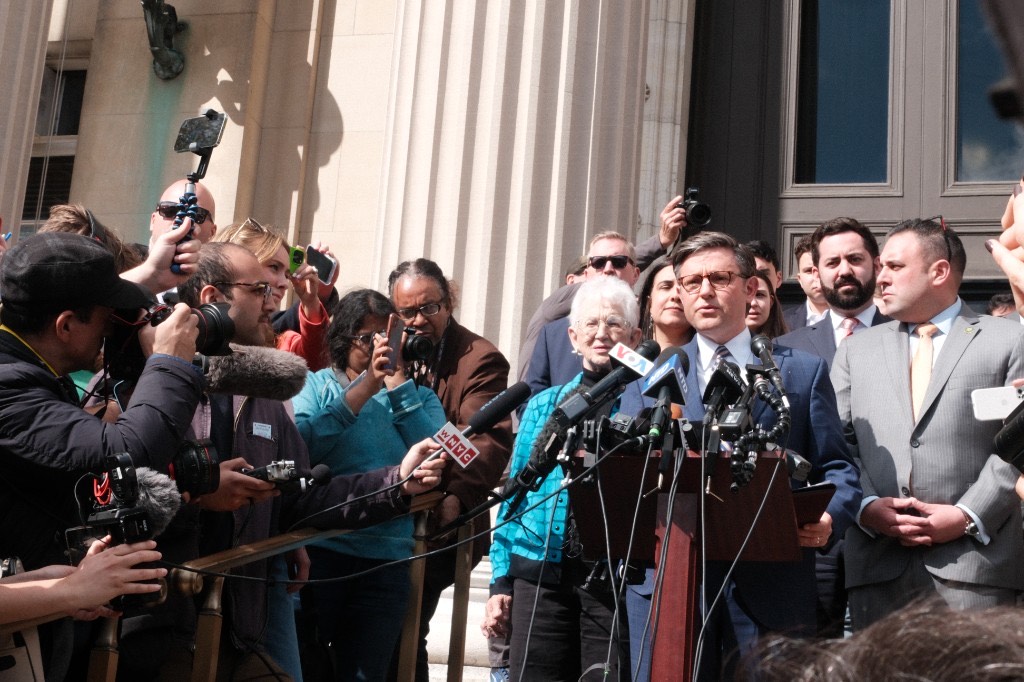
One week after the first mass arrests on Columbia’s campus, the protest had drawn the attention of the most powerful figure in the House of Representatives. On April 24, Speaker Mike Johnson traveled to Morningside Heights and held a press conference on the steps of Low Library — just yards from the encampment he came to condemn.
 Speaker Mike Johnson addresses a bank of microphones on the steps of Low Library. Republican lawmakers stand behind him as journalists and camera operators press in from every side. April 24, 2024.
Johnson, flanked by Republican members of Congress, called on President Shafik to resign and suggested that the National Guard could be called in to restore order if the university could not. He described the encampment as a threat to Jewish students and accused the administration of failing to act. The remarks echoed the congressional pressure that had already forced the resignations of the presidents of Harvard and Penn earlier in the academic year.
The visit drew an extraordinary concentration of media to campus. Earlier that afternoon, the press corps had assembled near the Alma Mater statue at the center of Columbia’s main quad, cameras and telephoto lenses pointed in every direction.
 Dozens of journalists, photographers, and camera crews pack the area near the Alma Mater statue on Columbia’s campus. The encampment’s tents are visible on the lawn behind them, with Butler Library in the background. April 24, 2024.
The scene was a study in scale: professional photographers with long telephoto lenses stood shoulder to shoulder with students holding up phones, broadcast cameras jostled for position alongside boom microphones, and press credentials dangled from every other neck. Behind the media scrum, the tents of the Gaza Solidarity Encampment were plainly visible on the lawn — the very thing all of these lenses had come to document.
 A wider view of the press conference on the steps of Low Library. Reporters, photographers, and onlookers crowd the entrance as lawmakers address the media. April 24, 2024.
From a wider angle, the full scope of the media presence became clear. The columned entrance to Low Library — a building that itself houses Columbia’s administrative offices — was enveloped by bodies, microphones, and cameras. What had started as a campus protest was now a fixture of the national news cycle, with the Speaker of the House standing on a university’s front steps demanding action.
Students, for their part, were unswayed. The encampment remained. Negotiations between protest organizers and the administration would continue for five more days before collapsing entirely on April 29.